
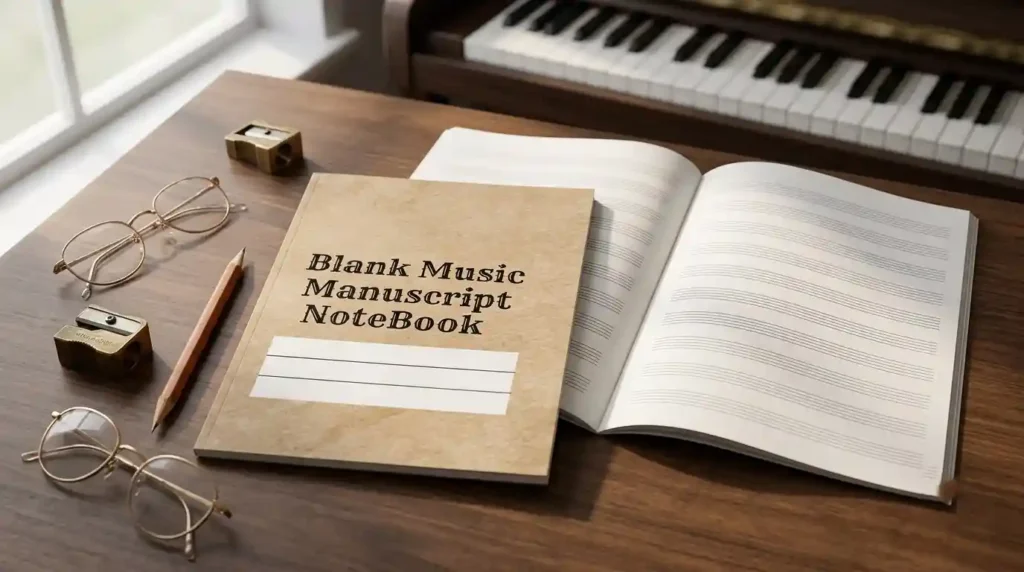
A dependable blank sheet music notebook provides that grounding space. When you take a physical pencil to paper, you bypass the friction of software menus, screen glare, and latency. You give your ear room to breathe and your hand the freedom to capture counterpoint, chord progressions, or simple daily exercises without digital distraction.
Why a Blank Sheet Music Notebook Beats a Screen
Digital notation programs have their place in late-stage production, but they frequently constrain the early drafting phase. Notation software tends to push you toward rigid quantization and preset rhythmic divisions before you have even decided where a melody naturally breathes.
Working with a tangible blank sheet music notebook reclaims the organic rhythm of creation:
- Stronger Cognitive Connection: Hand-drawing notes engages fine motor memory, reinforcing interval recognition and harmonic structures far more deeply than clicking a mouse.
- Zero Distractions: Real paper will never ping you with software updates, interrupt you with notifications, or run out of battery mid-phrase.
- Complete Creative Freedom: Sketching chord frames, ledger lines, dynamic markings, and margin notes is instantaneous and intuitive.
Much like how children and budding authors flourish through creative storytelling—as explored in our collection of inspiring stories for kids—young musicians and adult composers alike require an inviting, tactile medium to turn their imagination into tangible art.
The Ergonomic Power of a Wide-Staff Blank Sheet Music Notebook
Most standard manuscript pads make a frustrating design error: they compress 12 to 14 hairline staves onto a single page. For experienced engravers creating miniature orchestral scores, that tight density might suffice. For learners, instrumentalists, and educators, it simply creates visual fatigue.
A thoughtfully designed blank sheet music notebook utilizes a generous 9-stave format on crisp 8.5″ x 11″ pages. This intentional spacing offers concrete advantages:
- Clear Ledger Lines: Extra breathing room between staves ensures high treble and low bass notes never overlap or blur together.
- Dedicated Annotation Room: Ample white space leaves comfortable room for Roman numeral analysis, fingering guides, or lyric notes.
- Universal Clef Flexibility: Whether you write for solo cello in bass clef, flute in treble clef, or grand staff for piano, the unassigned wide lines adapt to any voice.
| Feature | Standard Manuscript Paper | Payel Chakravarty’s Wide Staff Notebook |
|---|---|---|
| Stave Count | 12–14 (Cramped) | 9 Staves (Spacious) |
| Dimensions | Varies / Pocket Size | 8.5″ x 11″ Standard Sheet |
| Page Capacity | 48–64 pages | 125 Pages |
| Target Audience | Advanced Engravers | Students, Songwriters & Composers |
How to Organize Your Blank Sheet Music Notebook for Success
A manuscript journal becomes a lasting record of your musical evolution when used consistently. Rather than scattering exercises across disposable loose sheets, keeping a single volume keeps your best ideas intact.
Consider dividing your 125 pages into three intentional working zones:
- Theory & Technique (Pages 1–35): Dedicate the front section to transcribing scale fingerings, arpeggio cycles, and modal patterns.
- The Idea Incubator (Pages 36–85): Reserve the middle pages for raw songwriting hooks, chord progressions, and rhythm sketches.
- Finished Arrangements (Pages 86–125): Use consecutive double-page spreads to write out complete, performance-ready pieces.
Bring Your Compositions to Life
Every piece of music deserves a dedicated home. The Large Staves Manuscript Book: Blank Sheet Music Notebook by Payel Chakravarty delivers 125 generous pages printed on clean paper with an open 9-stave layout. It provides musicians of all ages the clarity and room they need to write, practice, and create without boundaries.

Frequently Asked Questions
Who benefits most from a wide 9-stave music notebook?
A 9-stave format is ideal for music students, beginners, music teachers, and songwriters. The generous vertical spacing makes note reading simpler, supports larger handwriting, and leaves comfortable room for chord symbols, fingerings, and written lyrics.
What clefs are supported in this manuscript notebook?
All lines are neutral and unassigned, so it supports every clef—including treble, bass, alto, tenor, and percussion lines. You can easily pair staves into grand staves for piano, keyboard, and harp.
Why choose a paperback notebook over loose printable staff sheets?
Loose sheets tear, curl, and get misplaced easily. A bound 125-page paperback notebook keeps your practice history, musical drafts, and polished works organized chronologically in one durable, portable collection.