
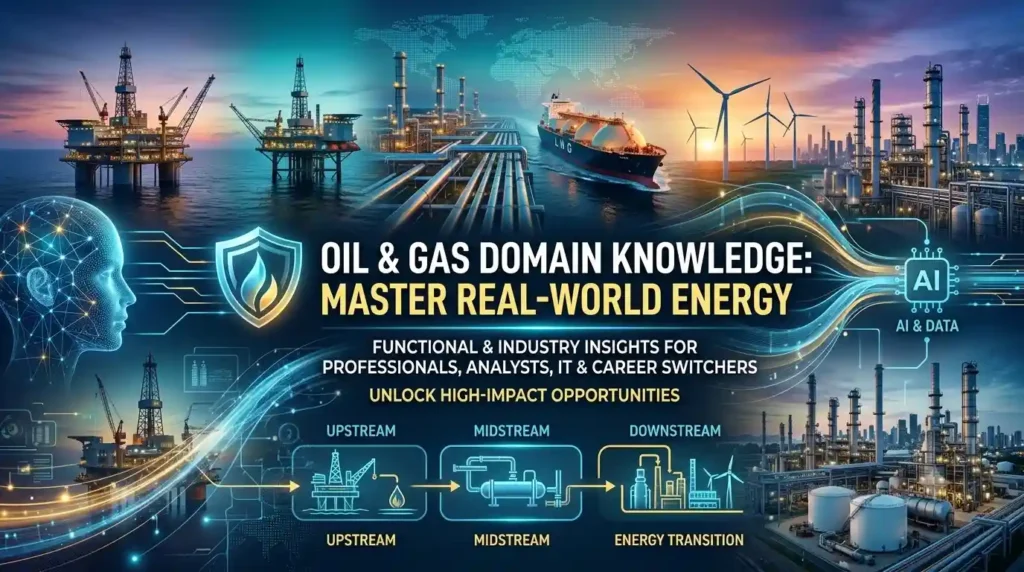
Much like mastering complex regulations when acquiring US healthcare domain knowledge, excelling in energy requires understanding the operational throughline. You do not need decades on an offshore rig; you need to understand how physical hydrocarbons, commercial contracts, and digital infrastructure connect from wellhead to burner tip.
What True Oil and Gas Domain Knowledge Actually Entails
Industry competence is not memorizing geology manuals. It is knowing how an operational decision upstream ripples through midstream logistics, trading desks, and downstream distribution.
The sector splits into three primary segments, each operating under distinct commercial logic:
- Upstream Operations: Encompasses exploration, drilling, reservoir evaluation, field data capture, and production accounting. The primary objective is getting hydrocarbons out of the ground safely and measuring output accurately.
- Midstream Logistics: Focuses on pipeline nominations, batch scheduling, compression stations, tank farm storage, and pipeline integrity management. This sector links production basins to wholesale demand centers.
- Downstream Delivery: Spans complex refining processes, product blending, rack pricing, wholesale distribution, and retail fueling networks.
Beyond these core pillars sit Natural Gas and LNG value chains, which rely on liquefaction, regasification, long-term Sale and Purchase Agreements (SPAs), and basis pricing differentials. When you understand how these segments talk to each other, you stop guessing requirements and start leading conversations.
Why IT and Business Professionals Struggle Without Context
Many enterprise tech implementations and advisory projects stall not because of software bugs, but because external teams misunderstand operational realities. If you build digital architecture without contextual oil and gas domain knowledge, critical operational gaps emerge quickly:
- The SCADA-to-Cloud Divide: Industrial control systems operate under millisecond tolerances and air-gapped safety protocols. Recommending standard consumer cloud pipelines without operational technology (OT) safeguards alienates plant managers immediately.
- Energy Trading and Risk Nuance: Energy Trading and Risk Management (ETRM) engines are not generic retail checkout systems. They track physical scheduling alongside financial derivatives, Value at Risk (VaR), pipeline storage imbalances, and complex settlement rules.
- Finance and Accounting Complexities: Standard corporate accounting does not mirror Joint Venture Accounting (JVA), Depletion, Depreciation, and Amortization (DD&A) calculations, or reserve-based lending mechanics.
Mastering these functional workflows enables IT consultants, project managers, and business analysts to configure solutions that fit the exact operational reality of field teams.
High-Leverage Workflows: Moving From Jargon to Execution
To deliver immediate value on cross-functional energy initiatives, professionals must focus on core operational frameworks rather than theoretical speculation:
- Health, Safety, and Environment (HSE): Process safety management, emissions tracking, and audit protocols take priority over raw production quotas on every major asset.
- Asset Lifecycle Management: From Capital Expenditure (CapEx) stage-gates to Operations and Maintenance (OpEx) turnarounds and ISO 55000 standards, capital allocation follows rigid structural gates.
- Digital Transformation Realities: High-ROI energy tech prioritizes predictive maintenance digital twins, remote production monitoring, and operational pipeline analytics rather than generic hype cycles.
- The Energy Transition Balance: Modern energy firms operate integrated portfolios. Gaining fluent literacy in small modular reactors (SMRs), hydrogen infrastructure, carbon capture, and battery storage alongside crude fundamentals keeps your perspective durable.
Frequently Asked Questions
Do I need an engineering background to work in the energy sector?
No. Major energy operators, trading houses, and consultancies employ thousands of business analysts, ERP consultants, supply chain specialists, and financial modelers who rely on functional process knowledge rather than physical engineering degrees.
What is the fastest way to learn energy value chains?
Trace the physical molecule. Follow a unit of natural gas or crude from subsurface exploration through production manifolds, midstream pipelines, liquefaction or refining, and finally to wholesale trade settlement.
Why is domain knowledge more valuable than pure technical skill in energy?
Technical skills like SQL, SAP, or Python are widely available. The ability to translate field operations, pipeline nominations, and regulatory constraints into functional data models is rare, making domain-literate professionals far more effective.
Turning operational complexity into professional momentum comes down to having the right blueprint. If you are preparing for an energy project or pivoting your career into the sector, Payel Chakravarty’s Oil, Gas & Energy Domain Knowledge delivers an executive-ready breakdown of processes, frameworks, and workflows across the global value chain. It provides the field-tested clarity needed to step into any energy environment and contribute from day one.
