
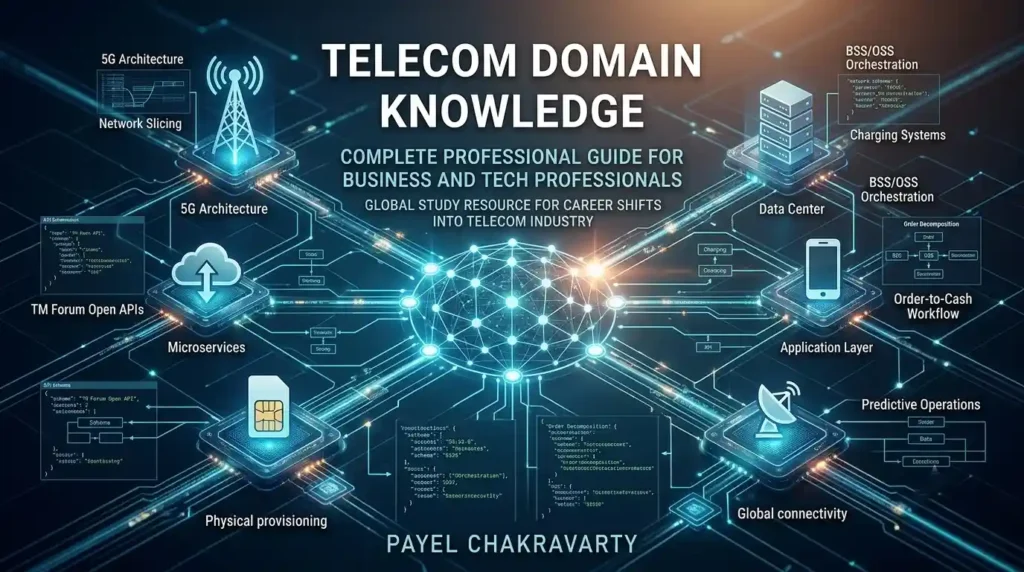
Stepping onto an enterprise telecommunications project without foundational industry context is often a disorienting experience. Complex three-letter acronyms fly across sprint boards, and legacy systems interact with bleeding-edge network layers in non-intuitive ways. Acquiring functional telecom domain knowledge is the definitive turning point where raw technical talent transforms into high-impact execution for Business Analysts, Software Engineers, QA testers, and Project Managers.
Enterprise telecommunications is far more than traditional software layered on top of standard relational databases. It functions as an intricate mesh connecting physical spectrum infrastructure, automated network orchestration, and customer-facing commerce. Just as transitioning into logistics requires foundational supply chain domain knowledge for career growth, telecom demands an intimate grasp of industry-specific data flows and architecture.
Why Telecom Domain Knowledge Anchors Modern Tech Careers
Technical fluency alone cannot bridge the gap between abstract business requirements and carrier-grade networks. When an operator manages tens of millions of concurrent data sessions, even a routine billing change or catalog update ripples across multiple interconnected platforms.
Professionals who possess structured telecom domain knowledge see the hidden dependencies behind user stories. They avoid the common pitfalls that stall agile deliveries, such as assuming a SIM activation workflow functions like a standard e-commerce transaction:
- Cross-Layer Visibility: Understand how customer self-service portals map directly to low-level network provisioning and mediation engines.
- Precise Requirement Scoping: Enable Business Analysts to draft clean functional specifications utilizing TM Forum Open Digital Architecture (ODA) patterns.
- Targeted Quality Assurance: Equip QA teams to identify defect clusters across rating, charging, and mediation systems before code reaches staging environments.
- Accurate Risk Forecasting: Help Project Managers proactively manage dependencies between third-party network equipment providers and internal billing stacks.
The Dual Engines: Demystifying BSS and OSS Architecture
To navigate telecom operations, tech professionals must clearly understand the operational boundary and handoff points between Business Support Systems (BSS) and Operations Support Systems (OSS).
   [ Customer Touchpoints: Web, App, Retail, Care ]
                          │
                          ▼
   ┌──────────────────────────────────────────────┐
   │         Business Support Systems (BSS)       │
   │  CRM • Product Catalog • CPQ • Order Mgmt    │
   │  Billing • Revenue Assurance • Charging      │
   └──────────────────────┬───────────────────────┘
                          │ (TM Forum Open APIs)
                          ▼
   ┌──────────────────────────────────────────────┐
   │       Operations Support Systems (OSS)       │
   │  Service Order Orchestration • Inventory     │
   │  Provisioning • Activation • Fault / EMS     │
   └──────────────────────┬───────────────────────┘
                          │
                          ▼
   [ Core Network & Edge Infrastructure: 4G/5G, RAN ]
1. Business Support Systems (BSS)
BSS manages the customer-facing commercial journey. It handles commercial transactions, tracks subscriber identity, and protects incoming revenue streams.
- CRM & Product Catalog: Centralizes commercial bundles, contract rules, and pricing logic.
- Order Management & CPQ: Configures, validates, and tracks customer purchase orders.
- Convergent Charging & Billing (OCS/CCS): Computes real-time usage charges for data, voice, and digital subscriptions.
- Revenue Assurance: Reconciles network usage events against billing outputs to eliminate revenue leakage.
2. Operations Support Systems (OSS)
OSS governs the technical reality of the network. Once an order passes commercial validation in BSS, OSS executes physical and logical fulfillment.
- Service Order Orchestration: Decomposes commercial orders into actionable network provisioning tasks.
- Network Inventory Management: Catalogs physical equipment (towers, switches, fiber) and logical assignments (IP ranges, IMSIs).
- Service Assurance & Fault Management: Monitors real-time network health, isolates performance anomalies, and automates trouble ticketing.
Modern architectures integrate these systems through standardized TM Forum Open APIs, replacing cumbersome proprietary point-to-point connections with modular, cloud-native microservices.
Core Operational Workflows: The Order-to-Cash Lifecycle
Navigating day-to-day project tasks requires an understanding of how data flows across delivery boundaries. The Order-to-Cash (O2C) lifecycle represents the most fundamental end-to-end process in telecommunications.
- Order Capture & Validation: A customer purchases an unlimited 5G plan online. BSS validates credit limits, geographic coverage, and SIM compatibility.
- Order Decomposition: The commercial order is translated into technical tasks, separating physical SIM shipping from digital profile configuration.
- Service Orchestration: OSS systems coordinate with Element Management Systems (EMS) to allocate network bandwidth and define service slices.
- Activation & Provisioning: The core network (UDM/HSS) registers the subscriber identity and attaches network entitlements.
- Real-Time Rating & Invoicing: As usage begins, the 5G Charging Function tracks data consumption and triggers automated invoicing cycles.
Understanding this continuous lifecycle allows engineering and delivery teams to rapidly debug operational issues and isolate precisely where an order is held up.
The Modern Shift: 5G Slicing, Cloud BSS, and AI Operations
Modern telecom domain knowledge extends beyond traditional legacy architectures into cloud-native design patterns:
- Network Slicing: Partitioning a shared physical 5G infrastructure into dedicated virtual pipes tailored for ultra-low latency, massive IoT, or high throughput.
- Cloud-Native BSS/OSS: Containerizing core monetization engines on Kubernetes to scale dynamically during usage spikes.
- AIOps & Predictive Assurance: Deploying machine learning models to detect subtle network degradation patterns and trigger automated remediation before service is interrupted.
Frequently Asked Questions
What roles benefit most from building telecom domain knowledge?
Business Analysts, QA Testers, Enterprise Solution Architects, Software Developers, and Technical Project Managers benefit significantly. Telecom service providers, system integrators, and software vendors consistently prioritize candidates who understand industry data models and operational patterns.
How does telecom business analysis differ from standard IT business analysis?
General IT business analysis often centers on isolated application workflows. In telecom, a Business Analyst must design solutions that respect complex regulatory mandates, legacy mediation engines, multi-system orchestration pipelines, and industry-standard frameworks such as TM Forum eTOM and SID.
What are TM Forum Open APIs, and why are they important?
TM Forum Open APIs are industry-standard RESTful interfaces. They enable telecom service providers and independent software vendors to integrate BSS and OSS solutions without building expensive custom connectors from scratch.
Master Telecom Architecture with Practical Reference Frameworks
Gaining domain clarity does not require sifting through disjointed online forums or generic overviews that lack real-world depth. For a zero-fluff manual organized with structured frameworks, architecture breakdowns, checklists, and 150+ interview scenarios, explore the comprehensive reference manual: Telecom Domain Knowledge: Complete Professional Guide for Business and Tech Professionals by Payel Chakravarty.
